

On September 2, 1929, a reporter phoned Evangeline Adams, an astrologist, to ask her opinion of the stock market. The publisher of a successful newsletter, the matronly, pince-nez-wearing Adams often dispensed investment advice from her Carnegie Hall office. Her clients reportedly included A-list celebrities such as Mary Pickford and Charlie Chaplin, as well as, before his death, the legendary financier J.P. Morgan.
“The Dow Jones could climb to heaven,” Adams told the reporter.
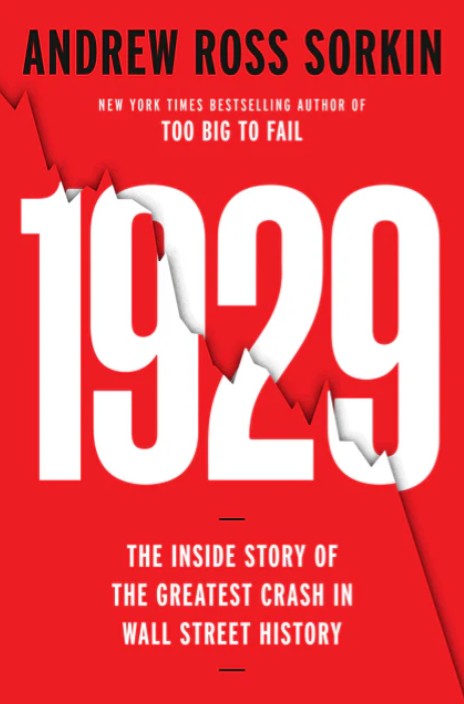
The next day, the market hit an all-time high. But, as Andrew Ross Sorkin chronicles in his book 1929: Inside the Greatest Crash in Wall Street History—and How it Shattered a Nation, less than two months later, the Dow Jones dropped into hell, pulling the rest of the nation down with it.
Sorkin’s book is a deeply researched, highly readable account of the most famous market panic in history. It bursts with rich scenes and vivid characters. But its greatest strength is its humility. Sorkin is interested in telling a story rather than Monday-morning quarterbacking. And what commentary he does indulge in is more compelling for its restraint. The result is an entertaining read that avoids using the crash and the subsequent Great Depression to advance a present-day political agenda.
Financial markets have long attracted large egos. In William Faulkner’s The Sound and the Fury, published in 1929, the villainous Jason is bitter about a hardware store job he feels is beneath him. He spends his workdays speculating in cotton markets with stolen money, an activity at which he mostly fails.
At the other end of the success spectrum, the real-life speculator Jesse Livermore rose from poverty to become one of Wall Street’s leading wizards in the 1920s. As Sorkin notes, Livermore “kept the thin paper strip that fed from [a stock ticker] running through his fingers throughout the day. …He studied the numbers with the intensity of a scientist, as if he were trying to solve an eternal mystery.”
Unlike long-term investors such as Warren Buffett, such speculators had a compressed field of vision. They cared about what stocks would be worth next week, not next year. And they were more concerned with crowd psychology than business valuation. In the frenzy of the 1920s, there was no shortage of such “operators,” to use a term of that era. Stock investing had recently been democratized, and the market became, according to Sorkin, “a spectacle that drew Americans to it like moths to a flame.” Everyone from newspaper boys to Groucho Marx was getting in on the action, expecting quick gains. When such easy optimism combines with loose credit — many investors were buying stocks on a razor-thin 10-percent margin — the ingredients for financial panic fall into place.
As Sorkin notes, some prognosticators, such as Roger Babson, economist and founder of Babson College, saw the crash coming. Others, such as Irving Fisher, the Yale economics professor, did not. When the bottom fell out on October 29, Black Tuesday, people on Wall Street “walked around like zombies,” according to industrialist and financier Arthur A. Robertson.
“It was like [the play] Death Takes a Holiday,” Robertson added.
Winston Churchill was in New York City at the time. That night, from his hotel window, he noticed that a man had jumped from the building and been “dashed to pieces” on the street below. Whether this was market-related or even a suicide rather than an accident is uncertain. Contrary to popular belief, suicides in the months following Black Tuesday actually declined from the preceding summer. But as the depth and severity of the Great Depression became apparent, that changed. In 1932, the nationwide suicide rate reached an all-time high of 22.1 per 100,000 people.
The real problem, which Sorkin’s book clarifies, was not the crash itself. Such things had happened before. It was the stubborn inability of the nation to recover from it, what Sorkin terms a “relentless unraveling.” By the late spring of 1930, almost half the market losses of the previous October had been made up. Yet optimism didn’t rebound, and credit didn’t loosen. Unemployment spread, and banks began collapsing like dominoes.
Where can we lay the blame? Communists, whose numbers swelled during the Great Depression, said it was the free market system. An inexorable cycle of financial collapses would grow progressively worse until the impoverished were united in violent revolution to usurp the means of production. Subsequent economic history safely refuted this claim. Capitalist economies have only grown progressively richer across the oscillations of the business cycle.
British economist John Maynard Keynes, on the other hand, said the capitalist system was sound but needed government management in the form of expansionary spending during downturns. This appeared to be borne out when World War II finally put the Great Depression into the world’s rearview mirror. And while the failures of Keynesian economic thought in the 1970s damaged its theoretical prestige, the general belief remains common today. In the twenty-first century, both Republican and Democratic administrations have tried to juice the economy through expansionary fiscal policy, with mixed results.
Writing three decades after the Great Depression, Milton Friedman and Anna Schwartz laid the blame at the marble steps of the Federal Reserve, which had contracted the money supply between 1929 and 1933. And their case remains as strong as ever. In a 2002 speech at the University of Chicago on Friedman’s 90th birthday, Federal Reserve Governor Ben Bernanke fessed up on behalf of the institution: “I would like to say to Milton and Anna: Regarding the Great Depression. You’re right, we did it. We’re very sorry. But thanks to you, we won’t do it again.”
And what of the Smoot-Hawley Tariff Act, which increased US tariffs an average of 59.1 percent? President Herbert Hoover, under heavy political pressure, signed it into law in the summer of 1930. Retaliatory tariffs from other nations followed. By 1933, global exports had fallen 64 percent from 1929 levels.
Sorkin doesn’t use much ink analyzing these causal factors. He stays focused on the story. But in the years after the crash, the American public was hurt and wanted human villains. Chief among these, in the popular mind, was Charles Mitchell, president of National City Bank (today’s Citibank). Known as “Sunshine Charlie” for his inveterate optimism, he was, at the time of the crash, one of the stock market’s biggest promoters.
Eventually, the federal government brought Mitchell up on criminal charges. He was acquitted; a jury could not find that he had broken any laws. His actions as president of National City, however, helped set the stage for the Glass-Steagall Act of 1933, which forced banks to separate commercial and investment banking.
Today, the 1929 crash is remembered as a historic challenge to capitalism. But financial corrections are arguably a feature of the system rather than a bug. Unlike dictatorial and collective economies, free markets remain tethered to reality. When things get out of balance, market forces trigger a reckoning from which healthy growth can restart.
Winston Churchill understood this. Shortly after the crash, he wrote of the “strength of the American speculative machine. It is not built to prevent crises, but to survive them.”
“No one could doubt,” he continued, “that this financial disaster, huge as it is, cruel as it is to thousands, is only a passing episode in the march of a valiant and serviceable people who, by fierce experiment, are hewing new paths for man and showing to all nations much that they should attempt and much that they should avoid.”
In 1945, the United States emerged from World War II as the strongest economy in the world, a position it has yet to relinquish. The crash of 1929 was a bump in the road rather than a brick wall.
Sorkin’s account of it is a fair and balanced addition to the literature.





0 Comments