

One morning in Boston in 1895, as K. C. Gillette stood before the mirror, a brilliant idea flashed across his mind. “As I stood there with the razor in my hand, my eyes resting on it as lightly as a bird settling down on its nest — the Gillette razor was born. I saw it all in a moment, and in that same moment many unvoiced questions were asked and answered more with the rapidity of a dream than by the slow process of reasoning. I stood there before that mirror in a trance of joy at what I saw.”
He quickly wrote a letter to his wife, “I have got it; our fortune is made.”
Simple ideas often appear obvious in retrospect, but simplicity is usually the far edge of genius.
Men’s facial fashions were shifting rapidly in the late 1800s: the beard was out, the clean-shaven chin was in, and the mustache had to be perfect. To maintain this look, men either visited the barber two or three times a week, or shaved themselves, a risky alternative. The “cutthroat” straight razors demanded constant sharpening, and punished even small mistakes — especially for beginners or anyone pressed for time.
Gillette’s insight was simple: don’t sharpen the blade — replace it with something safe, affordable, and convenient.
The Long Road to Innovation
King Camp Gillette was born in 1855 in Wisconsin and grew up in Chicago in a family of tinkerers. His father was a part-time patent agent who encouraged experimentation and invention, while his mother obsessed over efficiency and avoiding wasted time.
After the Great Chicago Fire destroyed the family business in 1871, Gillette went to work as a clerk before moving to New York City and becoming a traveling salesman. For nearly two decades he worked various jobs while constantly trying — and mostly failing — to invent useful products.
In 1890, he joined the Baltimore Seal Company, where the company president had invented the disposable Crown Cork bottle cap. He told Gillette: “Why don’t you invent something that, when once used, is thrown away, and the customer keeps coming back for more?” Gillette never forgot the advice.
It took Gillette six years to transform his brilliant shaving revelation in Boston into reality. Gillette noted, “The razor was looked upon as a joke by all my friends. A common greeting was, ‘Well, Gillette, how’s the razor?’ If I had been technically trained, I would have quit.” He visited metallurgists at the Massachusetts Institute of Technology (MIT), who assured him his idea was impossible.
Building the Impossible Razor
He finally found engineer William Emery Nickerson, who believed the idea was possible, and together they worked several years to perfect the thin blade, double-edged safety razor.
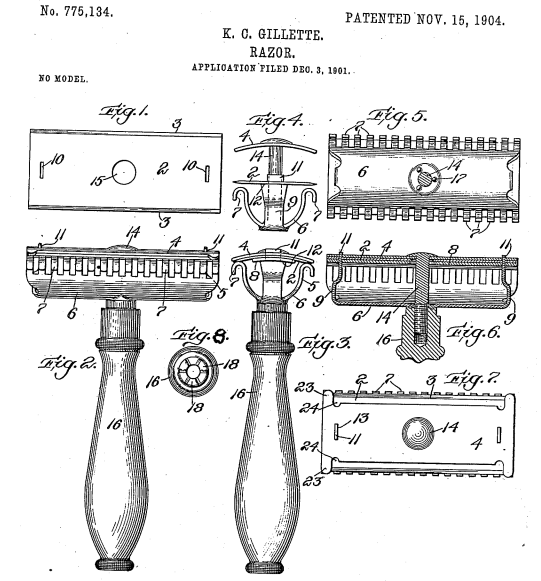
Gillette applied for a patent in 1901, but struggled to raise the capital to begin production until John Joyce, an old friend and businessman, invested $5,000 in the venture.
An invention and a patent are only the beginning. They do not become true innovations until they can be produced profitably, and at scale. Perhaps even more important than the blade itself, Nickerson designed the machinery that made mass production possible. Gillette understood that learning curves, precision manufacturing, and scale would not merely improve shaving — they would revolutionize it.
The company produced its first razors in October 1903. Sales for the inaugural year: 51 razors and 168 blades. The patent was formally issued in 1904, and the company sold 91,000 razors and more than two million blades that year.
Transformation is often invisible before it becomes inevitable.
Mass Production Arrives
A big break came in World War I when Gillette was able to sell the US government 3.5 million razors and 32 million blades. Clean-shaven faces ensured a proper seal for gas masks. Gillette had to hire more than 500 new employees, who worked around the clock to fulfill the order.
An invention became infrastructure.
Gillette became forever associated with the famous phrase: “Give ’em the razor; sell ’em the blades.” There is no evidence he actually said it, but no sentence better captures the revolution he unleashed.
Engineering Repeat Consumption: a New Business Model
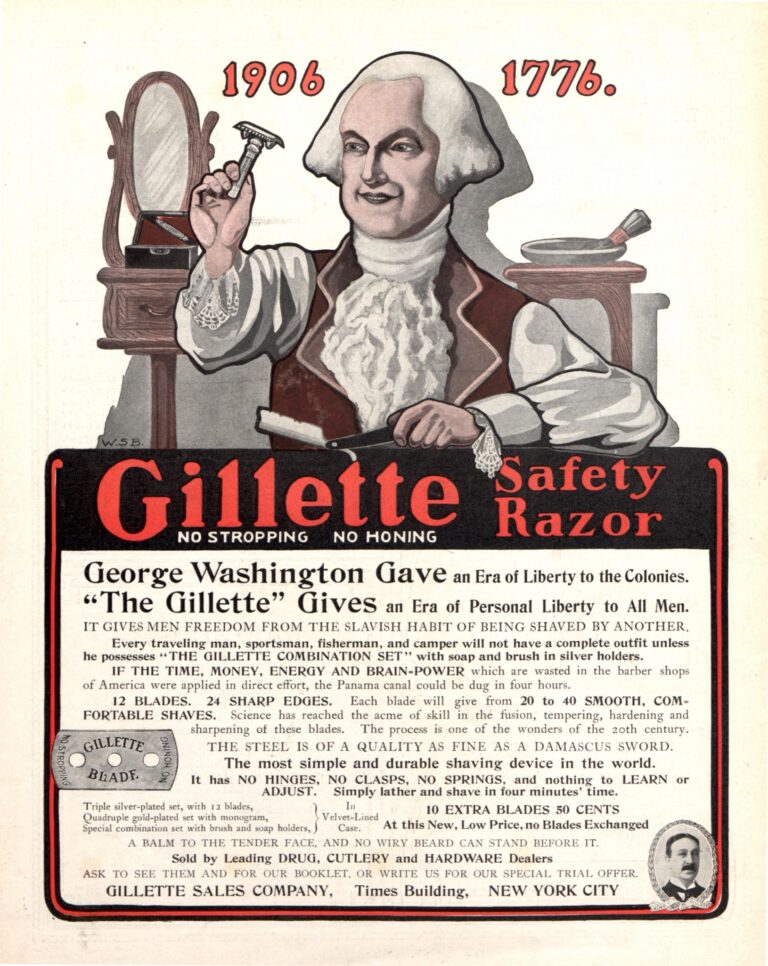
Ever obsessed with efficiency, Gillette viewed the old barber-shop culture as an enormous waste of human time and productive energy. One 1906 advertisement boldly claimed: “If the time, money, energy, and brain-power wasted in the barber shops of America were applied in direct effort, the Panama Canal would be dug in four hours.”
Gillette was not merely inventing a product to save time. He was inventing a business model. The razor was the platform; the blades created the recurring stream of revenue. More than a century before subscription software and hardware-as-a-service, Gillette understood the power of repeat consumption driven by convenience, affordability, and habit.
To sustain recurring blade sales, Gillette needed more than utility. He needed ritual, loyalty, and identity.
This is where advertising became his accelerator. His advertisements were among the first to harness the persuasive power of celebrity culture. One ad featured John McGraw, legendary manager of the New York Giants, declaring: “It makes shaving all to the merry.” Another showed George Washington holding a safety razor beside the slogan: “George Washington Gave an Era of Liberty to the Colonies. The Gillette Gives an Era of Personal Liberty to All Men.”
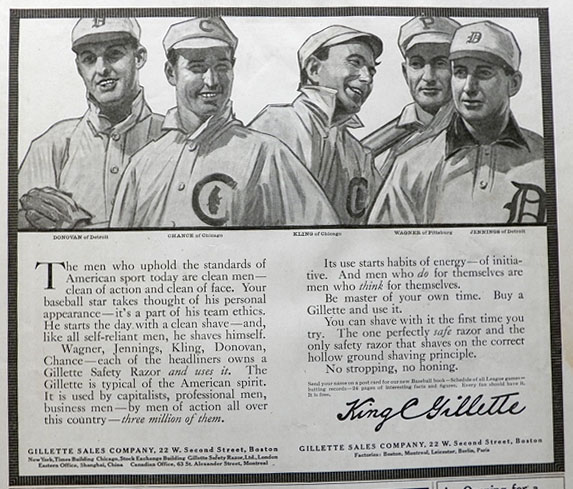
Gillette later enlisted baseball star Honus Wagner — perhaps the most famous athlete of his generation — and the campaign was a sensation. Gillette helped pioneer a new era of advertising in which products were no longer sold merely for their utility, but for the image and lifestyle they projected.
Under Gillette, shaving ceased to be a tedious chore performed with a dangerous blade. It became part of the modern masculine ideal. The right razor promised confidence, precision, cleanliness, and success — the same virtues embodied by the athletes and heroes in his advertisements.
Later, using an elaborate formula, Gillette figured that the monetary value of the time men saved each year using his razor was equal to the entire capital of US Steel, valued at around $1.5 billion at the time.
Unlocking Abundance Through Innovation
Yet beneath the marketing was a deeper insight: wealth is measured in liberated human time. Gillette’s true innovation was not the razor itself, but the gift of time — our scarcest resource.
Today, there are almost three billion adult men on the planet. If Gillette’s razor innovation saves each of them just five minutes a day, that amounts to 250 million hours liberated every single day.
Saving five minutes a day shaving was nice, but the biggest savings involved the time it took to earn the money to buy a shave.
In 1906, entry-level workers — equivalent to today’s fast-food restaurant employees — were earning around 10 cents an hour. At the time, it typically cost 10 cents to get a shave at a barber shop. Work an hour, get a shave. That year, you could buy the new Gillette safety razor with 12 blades for $5, a time-price of 50 hours. At the recommended ten shaves per blade, the price of a smooth face dropped 75 percent, to 2.4 cents.
There has been lots of razor innovation over the last 120 years. In fact, King Gillette said, “We’ll stop making razor blades when we can’t keep making them better.”
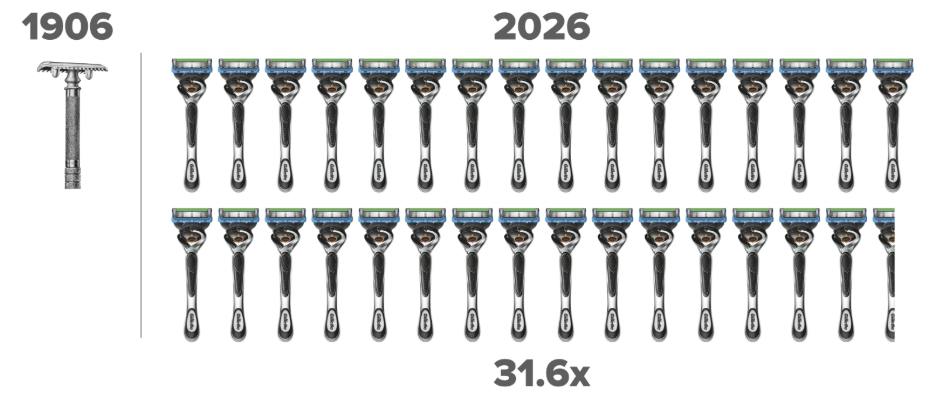
Today, you can get the Gillette Fusion5 ProGlide with six blade cartridges for $29.97. With average earnings at a limited-service restaurant today closer to $19.00 an hour, the time price is around an hour and 35 minutes for these workers. For the time it took to buy one in 1906, you get 31.6 today. Having tried one of the original Gillette blades and the Fusion 5, I can testify it’s like the difference between driving a ‘69 VW bug and a 2026 Lexus.
Believe it or not, there’s still a market for the original type of Gillette razor. Amazon sells a double-edged razor for $7.66. There are only five blades instead of 12, but the blades last much longer. This would put the time price for our limited-service restaurant workers at around 24 minutes. For the time it took to buy one in 1906, you get 125 today.
The best deal is Dollar General. They will sell you a 12-pack for $1.00, or 8.33 cents per razor. A five-pack would be around 42 cents. For the time it took to buy a Gillette in 1906, our capitalist friends at Dollar General will now sell you 2,262.
Depending on how you want to compare, since 1906 shaving-razor abundance has increased by a factor of 31.6 to 2,262. Anyone today can have a pretty good razor for just a few minutes of time.
From Luxury to Ubiquity
What began as a dull blade before a mirror in Boston became a revelation: knowledge can redeem time. Gillette became a global engine for transforming human ingenuity into billions of dollars of value and billions of liberated hours.
In 1903, Gillette sold 51 razors. A century later, Procter & Gamble purchased the company for $57 billion. Steel did not become more valuable. Steel is abundant and nearly worthless without the mind. The value resided in the invisible architecture of human creativity — metallurgy, machinery, chemistry, branding, logistics, engineering, and trust — accumulated across generations and poured into a single morning ritual. Accumulated manufacturing knowledge compressed time prices downward, making what was once a luxury nearly universal.
I have three sons. One of my great pleasures as a father has been teaching them to shave when they first sprouted whiskers. In that simple act lives a century of accumulated discovery passed from one generation to the next.
Gillette did not merely improve shaving. He helped reveal the central truth of economic progress:
When free minds are allowed to create, knowledge compounds.
When knowledge compounds, time is liberated.
And when time is liberated, abundance pours outward to everyone.
(And we all look a little better.)






0 Comments