

There’s something very ironic about extolling mercantilism at the Reagan Library. Scott Bessent did just that last week, arguing that America had been wrong to trust markets, wrong to value efficiency, and wrong to believe that “the invisible hand would correct vulnerabilities.”
Jamieson Greer followed this up with a piece in the International Monetary Fund’s F&D Magazine, where he declared that tariffs and import regulations had been unfairly cast aside by an “elite consensus” and that “the return of tariffs and import regulations creates an opportunity to update old assumptions and dated models with the hard evidence of real-world data and experience.”
These are not new arguments. For anyone who understands the history of economic thought, they are also easily rebuked. The argument against mercantilism is not new, and it is not difficult to understand. It is, however, very inconvenient for the current occupants of 1600 Pennsylvania Ave.
What is Mercantilism?
Briefly, mercantilism is the idea that a nation, not unlike a household, is wealthiest when it has large reserves of money. This was the animating idea behind economic policy up until nearly the end of the eighteenth century. Nations focused their attention on acquiring large sums of gold. To do this, they used policy to encourage exports and discourage imports. Exports were considered “good” because it meant that the nation acquired gold in an exchange. Imports were “bad” because they required giving up gold. Thus, the focus of a mercantilist system is on production, not on consumption.
This began to change in the late eighteenth century when Adam Smith published his treatise, An Inquiry into the Nature and Causes of the Wealth of Nations. The full title is worth spelling out here because what Smith does in this volume is not “defend free market capitalism,” but Inquire about The Nature of Wealth. Specifically, he asks, “what is wealth?” and his answer is quite simple: wealth is measured in what you can purchase. Tom Hanks in Cast Away still would have had to knock his own tooth out with an ice skate if he’d washed ashore with a trillion-dollar coin in his pocket. And therein lies the lesson: while you do need money in a modern economy, what matters is what you can actually do with that money, not how much money you have.
Neo-mercantilists accept this, but want to argue that national security concerns override this logic and that economists have somehow missed this. They call for updating economic models to be more in line with “tariffs, industrial policy, and the costs of globalization.”
They are wrong on both counts. Economists have not missed the national security argument. While there may be legitimate cases for protectionism in the name of national security, those cases are extremely limited and certainly do not justify tariffs on the entire world and the imposition of managed trade. The actual threats to American national security are not the product of being “too open” or “too dependent.” The risks we face today have been greatly overstated and are actually the fault of excessive government.
The Economists Were Wrong?
Greer opens his F&D piece with a riff on a Chesterton quote: for the past thirty years, “tariffs were not tried and found wanting but rejected by au courant economic models and left untried.” This is quite simply revisionist history. Every single president for the last thirty years has tried tariffs, and those tariffs were found wanting. Bill Clinton imposed tariffs on imported steel, automobiles, and bananas. George W. Bush imposed tariffs on steel. Then, President Obama imposed tariffs on Chinese tires because of alleged dumping. That then brings us to President Trump, who famously used tariffs during his first term, President Biden who expanded Trump’s tariffs (something the current Trump administration hasn’t shied away from pointing out), and now the second Trump presidency, which has obviously seen tariffs being used.
Far from being bastions of success, these were not just “found wanting,” they were disastrous and in most cases, lifted because of their pernicious effects. This wasn’t surprising. Economists warned about exactly this at the time. They were correct then, and they’re correct now.
Greer complains that trade models assume full employment and frictionless worker transitions. It’s a fair point; the models that economists use do contain simplifying assumptions. But the question we have to ask is whether these assumptions meaningfully affect the results of the analysis to the point of needing to be jettisoned. And the answer is a resounding “no.” Pointing out a model’s imperfections does not mean we jettison its underlying insights.
Washington Gave China the Edge, Not the Other Way Around
The Bessent-Greer framework would have us believe that American manufacturers have been competing in a game rigged by Chinese state subsidies and that we are “losing.” That American communities have been hollowed out by cheap imports and the offshoring of jobs and that American manufacturing is in decline. And they blame economists for naively supporting free trade when, in the words of Scott Bessent, “the warning lights were glaring all around us.”
As the old saying goes, when you point a finger at one person, you’ve got three more pointing back at yourself. And those three fingers are doing a lot of work, here.
American manufacturing is not in decline because of free trade. In fact, it could hardly be described as “in decline” to begin with. The truth is that manufacturing output in the US is quite high.
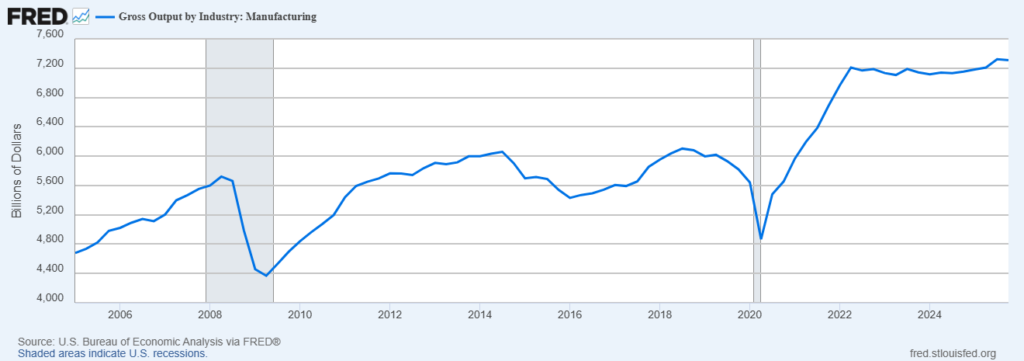
One would have to be very selective in choosing which data to examine to conclude that manufacturing is in decline, and even then, an honest accounting would include several paragraphs of caveats.
What is in decline is manufacturing employment. But this, again, is not because of “free trade” resulting in companies shipping jobs overseas or the so-called “China Shock” that occurred after China joined the World Trade Organization. It’s because of tremendous gains in productivity by the American worker — largely thanks to automation, advanced machinery, and improved production processes — combined with onerous regulatory burdens that made building new factories in America far too costly. The solution to this is not to make manufacturing at home more expensive through tariffs and other trade restrictions; it’s to make it easier for America’s manufacturing workers to acquire the materials they need to produce their output.
The truth of the matter is that the US has, on a per-capita basis, the most productive manufacturing sector on the planet. Not even the “mighty” China comes close. The US employs about 12.6 million manufacturing workers. China, by comparison, employs some 212 million. With nearly 200 million more manufacturing workers, China only outproduces us by about 60 percent.
What About National Security?
Here, we must concede that there is a shred of truth to the protectionist logic. If there is a genuine national security concern and if domestic production were the only way to mitigate these concerns, then protectionism might have a leg to stand on. But note the repeated use of qualifiers in that sentence. Each one deserves examination before we jump to, “therefore: use protectionism.”
The truth of the matter here, and one that protectionists simply do not acknowledge, is that what matters for national security concerns is ensuring domestic access. Domestic production is certainly one way of doing this, but it is far from the only way.
Consider the case of steel, clearly a critical material for national defense purposes. How dependent on foreign steel are we? The American Iron and Steel Institute reports that only 23 percent of finished steel in the US was imported. The Association for Iron & Steel finds that the US is the third largest producer of steel in the world. Where do we get the rest of our steel? According to the US International Trade Association, we get the rest of our steel from, in order: Canada, Brazil, Mexico, South Korea, Vietnam, Japan, Germany, Taiwan, the Netherlands, China, and 68 other countries. This is not a dependency. This is resiliency, as long as we do not push away our allies.
The exception to this would be a monopoly supplier of a critical material. China’s dominance of so-called rare earths provides a potential example. But here again, the question we should be asking is, “why is China the dominant supplier of these materials?” and the answer is staring us right in the face: excessive environmental and labor regulations. Once again, it’s not “free trade” that caused a vulnerability to China. It’s too much government standing in the way. The solution is not to fight government ineptitude with more ineptitude. It’s to get the government out of the way so that markets, not politicians, can actually solve the problems.
What Would Actually Work
The irony that Scott Bessent championed mercantilist justifications for protectionism by invoking Reagan’s name at the Reagan Library to an audience that presumably understands Reagan’s position is palpable. That Jamieson Greer did the same in the International Monetary Fund’s magazine is equally ironic. Restricting trade does not make a nation wealthier or safer, and it never has. Mercantilism has been wrong for the past 500 years, and it will be wrong for the next 500 years, too.
Instead, American interests, both economic and security alike, are best served through free trade and globalization. Trade between nations brings us closer together and vastly reduces the likelihood of war between trading partners. Globalization ensures that if war were to break out, access to critical materials for the war effort can remain uninterrupted. The real risks to America’s supply chains have been created by excessive regulation, not openness.
It’s time to end the experiment with tariffs once and for all. We need to be tearing down barriers to trade, not erecting new ones. Doing so would unleash the American worker on the rest of the world. Doing so will not only make us wealthier, it’ll make us safer, too.





0 Comments