

What are zoning laws, how do they work, and what are their economic effects?
This explainer is intended to be a guide to the purposes and mechanics of local land-use regulations, including zoning, as well as the economic debates over their effects, especially on the housing market, and how to reform them.
1. What Zoning Is
Zoning is a set of laws that regulate how property owners may use their land, in particular by drawing zones where certain uses are and are not permitted. Most zoning laws are local ordinances adopted by county or municipal governments, but some are state laws adopted by legislatures or executive agencies.
While zoning regulates building, “zoning codes” are different from “building codes.” Building codes are standards for construction meant to address life safety issues, such as fire safety and energy efficiency.
Planners and local governments often treat “zoning” separately from other land-use or development regulations. Regulations affecting the subdivision of land, the layout of site plans, and environmental standards like those having to do with development activities near wetlands or above aquifers are all closely related to zoning. Sometimes these laws are found in zoning ordinances and sometimes in separate ordinances. “Master plans” are typically advisory documents meant to inform zoning changes, but in practice, they often diverge sharply from what zoning ordinances actually allow.
Zoning is a relatively recent phenomenon in the United States. New York City adopted the first comprehensive zoning ordinance in 1916, but cities had implemented piecemeal land-use regulations before this date.[1]
Zoning quickly spread nationwide. Under Secretary of Commerce Herbert Hoover, the federal government adopted a draft “zoning enabling act” in 1924 and promoted its enactment by state legislatures. Most states quickly adopted zoning enabling acts in the 1920s. Excluding the then-territories of Alaska and Hawaii, the last state to adopt a zoning enabling act was Washington (1935).
Before zoning, land use was regulated through private covenants: contracts that limited how landowners could use their property, and that “ran with the land,” meaning they passed to future buyers and renters. Private covenants are still important in the US, but they are now used mainly for two purposes: creating conservation easements that limit development on agricultural land or wilderness, and establishing homeowners’ associations that manage common facilities and regulate development in a single neighborhood.
Why did zoning start in the 1910s and 1920s? One reason may be the rise of the automobile, which allowed workers for the first time to live far from their jobs. As suburban neighborhoods grew, residents sought to keep urban uses at a distance. Zoning was a tool for that separation.
Progressive Era optimism about the ability of experts to use scientific principles to re-engineer daily lives through government also played a role. Within the field of urban planning, the early progressives’ ambitions gave way in the 1940s and 1950s to even grander “high modernist” visions to redesign cities according to abstract principles of beauty and order (Scott 1998). These ideological commitments played a role in the American “urban renewal” projects of the 1950s and 1960s that bulldozed neighborhoods, widened roads, drove highways through the centers of cities, and rezoned land to require large parking lots and front yards.
Some scholars still debate whether racism played a role in the development and spread of zoning. Certainly, some cities tried to use zoning for racial and socioeconomic segregation, even after the Supreme Court struck down explicitly racial zoning in 1917. But there were also prominent black advocates of zoning (Glock 2022). FDR’s Federal Housing Administration (FHA) used redlining — excluding certain neighborhoods from their mortgage guarantee program — to reinforce urban segregation. To this day, many zoning boundaries follow the red lines that the FHA drew suspiciously closely (Rothstein 2017; Trounstine 2020). Urban renewal policies, especially interstate highway construction, damaged urban working-class areas of cities, both predominantly black and ethnic-white (Peterson 2023). Perhaps the most supportable conclusion is that racism sometimes played a role in the purposes to which zoning was put, but the level of racism in society is not a good predictor of the stringency of zoning over time, since especially restrictive forms of zoning first emerged in the 1960s and then spread to fast-growing regions during the period from the 1970s through the 2000s.
In fact, a social trend that tracks better with the rise of especially restrictive zoning is the spread of anti-growth environmental attitudes in the 1960s and 1970s (Fischel 2015). During this era, environmentalism was closely associated with anti-population-growth views, and ultra-low-density zoning seems to have emerged first in places with strong environmental movements. Up to the present day, local Sierra Club chapters have often been key vehicles for anti-housing activism (Elmendorf 2023), despite the fact that low-density zoning in metropolitan areas tends to encourage sprawl.
2. How Zoning Works
The basic role of zoning is to separate potentially annoying or noxious uses from residential neighborhoods. Economist William Fischel calls this “good housekeeping zoning” (Fischel 2015, 325).
Traditional zoning isn’t the only way to regulate nuisances. One former city planner and zoning skeptic notes that, rather than dividing a city into districts with different permitted uses, ordinances could simply specify that obnoxious uses may not locate within a certain distance from an existing home (Gray 2022). Under traditional zoning, a nuisance use can be located close to a home so long as it’s just over the line in a zoning district where that use is allowed.
From early on, zoning went beyond regulating genuine nuisances. The famous Euclid v. Ambler Supreme Court case that upheld the constitutionality of zoning in 1926 was about an ordinance that forbade the building of apartments in one part of the village of Euclid, Ohio. The majority opinion held that restricting apartments was a reasonable use of the government’s police power, since “very often the apartment house is a mere parasite, constructed in order to take advantage of the open spaces and attractive surroundings created by the residential character of the district,” and apartment houses in residential districts “come very near to being nuisances” (272 US 394–95).
Today, almost all zoning ordinances limit residential densities, even in the most densely populated neighborhoods in the country. Setting aside land for detached, single-family housing is also standard. Single-family zoning is virtually unknown outside the US and Canada (Hirt 2014), but limits on residential densities are near universal (Hughes 2025). Limits on densities may, within reason, safeguard the value of residential properties in a neighborhood.
Another application of zoning is to make sure that new development “pays its own way.” If new development requires building roads or expanding schools, zoning regulations can require the development to pay enough in property taxes to cover the marginal cost of providing these services. Requiring that new homes purchase a lot of land with their house, through minimum lot sizes, might be a roundabout way of doing this.
Another, arguably simpler way of ensuring that developments make fiscal sense for the local community is to use narrowly constructed impact fees. Impact fees are payments that property owners have to make in order to build a certain kind of development. These funds can then be used to upgrade infrastructure, hire teachers, or otherwise fulfill the need created by the new development.
Like any other government exaction, impact fees can be — and often have been — abused. They only make sense if they cover the net cost of a development to local property taxpayers. Since development typically raises the value of property substantially, it always pays at least part of its own way. The most credible academic research on this question suggests that multifamily housing and small-lot single-family subdivisions tend to pay their own way fully through their added property tax revenues, at least when it comes to school enrollment impacts (Gallagher 2016; 2019). If that’s true, then it wouldn’t make sense to impose school impact fees on these types of developments.
If a property owner wants to do something that is prohibited under zoning, localities offer processes for various exceptions. It’s impossible for a zoning ordinance and a zoning map to anticipate all possible valuable uses for every specific piece of land for all time. The most typical process is to obtain a “variance,” or a waiver of the zoning regulations in a particular instance.
Alternatively, the map itself can be changed through a rezoning — but this process usually makes sense only for large projects. These processes are at least somewhat discretionary; a property owner is never entitled to a variance or a rezoning.
3. Understanding Your Local Zoning
To see what kinds of regulations your area has, you can look up your local zoning or development ordinances and zoning map. Here’s what to look for.
In larger towns that have the assistance of professional staff in drawing up regulations, ordinances will typically have a table of uses and a table of dimensional regulations. The table of uses will tell you what uses are allowed or prohibited in each district, and the table of dimensional regulations will tell you the minimum and maximum requirements for lots and buildings.
Figure 1 shows a portion of a table of uses from Nashua, New Hampshire’s zoning ordinance. Like the vast majority of other zoning ordinances in the US, the Nashua ordinance considers a use prohibited unless it is expressly permitted. Some uses are only permitted if they are “accessory” to specific other uses, that is, they are not the main use of the land. Some uses are neither permitted nor prohibited outright, but require a special permit from a land-use board. These special permits are typically offered on a partially discretionary basis, such that a landowner has to prove that the new use will meet pre-established criteria.
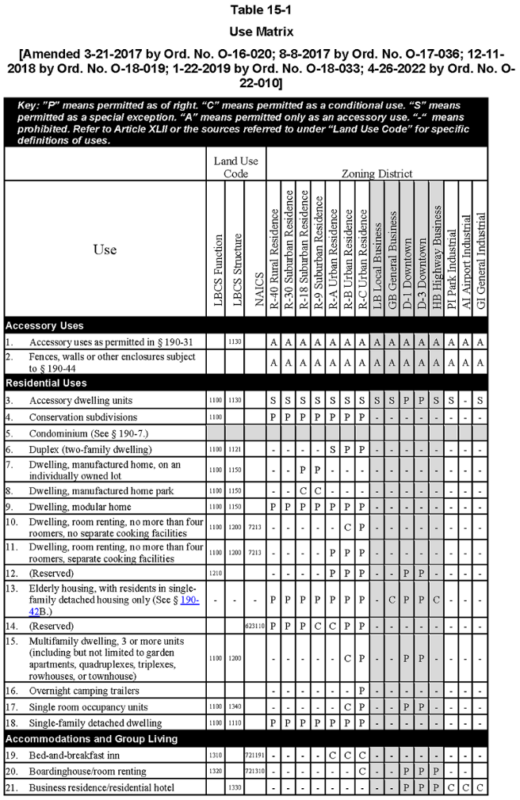
As you can see from Figure 1, the commercial uses that happen to be listed here — different kinds of lodging establishments — are not a permitted use in any of the residential districts, but they are in the downtown and business districts, and they are allowed by a special permit in some of the urban residential districts. This kind of separation of uses is typical.
Home businesses, however, are treated as an accessory use. Most zoning ordinances will allow home-based businesses in at least some neighborhoods, but they typically impose restrictions such as maximum square footage or maximum number of employees, to limit the size and impact of these businesses.
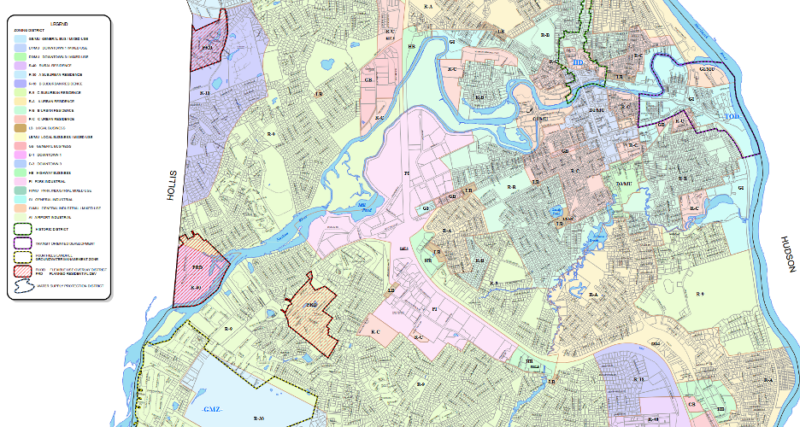
The zoning districts in the columns of Figure 1 are plotted on a zoning map. Figure 2 displays a portion of the zoning map for Nashua. There are two types of zoning districts on this map: base districts and overlays. Base districts correspond to the regulations that apply outside an overlay. An overlay district modifies the regulations in the base district in certain respects (but not others). These modifications could make the regulations stricter or less strict.
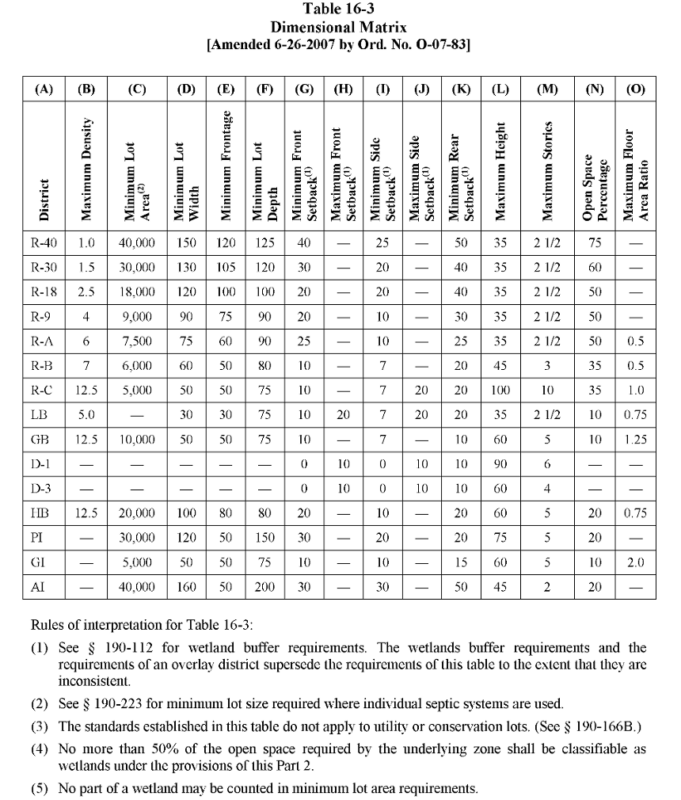
Finally, Figure 3 shows a portion of Nashua’s table of dimensional regulations. These regulations limit how much you can build. Maximum density regulations limit the number of dwelling units you can build per acre. Minimum lot sizes tell you how much land you must have per house. Minimum setbacks tell you how far back the building must sit relative to lot lines. Maximum setbacks are less common but are gaining in popularity as planners lose interest in the high-modernist ideal of low-slung buildings surrounded by seas of grass and asphalt. Floor area ratios limit how much floor space you can build relative to the size of the lot; they’re an especially complex way to limit building space. Finally, minimum open space percentages, sometimes specified as maximum lot coverages, are in theory justified as a flood-prevention measure, making sure there’s enough space for rainwater to permeate the soil. To use them properly for flood prevention, however, they would need to scale with the size of lots and the flood-proneness of the surrounding area. It might be more efficient sometimes just to pay people to keep some land as open space.
Regulating uses and dimensions aren’t all that zoning ordinances do, but they’re among the most consequential. A nationwide project to map and tabulate key zoning ordinances affecting housing development is underway: the National Zoning Atlas. If you’re lucky enough to have your area covered by this atlas, you can dig into the data and see what types of housing are allowed where. The “snapshots” tool lets you compare jurisdictions by the percentage of land area they make available for certain types of housing.
4. The Consequences of Zoning
Economists pay attention to zoning because zoning makes it harder and more costly to build housing. Zoning is also often the only tool residents possess to limit nearby land uses that may lower their own property values without constituting true nuisances.
Everyone agrees zoning raises the cost of housing, but debate continues over whether it does so primarily by restricting supply, or also by increasing demand. If zoning is a wise tool for regulating nuisances and making neighborhoods more pleasant, it should boost housing demand as well as constrain supply.
Zoning limits housing supply in two ways: raising monetary costs and raising time costs. We have already seen the first of these. Zoning often requires more land to be used to build than a property owner might prefer to buy. Zoning can also raise the monetary cost of building by requiring particular building features, such as parking spaces.
Zoning also raises the time cost of building housing. Getting approvals, especially for special permits or variances, takes time — often an uncertain amount of time.
Zoning raises the cost of housing in a way that more closely resembles a fixed, per-unit tax than a tax that scales with the value of the property (“ad valorem”). Developers have an incentive to develop higher-priced properties, so that the fixed “land use tax” represents a smaller proportion of the ultimate sale price. For this reason, we should be cautious about attributing rising housing costs solely to larger and higher-quality homes. Houses are probably inefficiently large and high-quality, especially in more regulated regions. Lots of Americans want starter homes but are unable to find them, because even a small house is costly to build in a manner consistent with zoning.
Some economists have found that zoning can raise the demand for housing and make neighborhoods nicer to live in, compared to the alternative of completely unregulated land use (Speyrer 1989; Lin 2024; Gyourko and McCulloch 2024).
Quite a few studies have found that stricter zoning makes housing development more costly and less efficient, and may even account for the otherwise hard-to-explain decline in construction productivity in the United States (Siegan 1972; Glaeser et al. 2005; Hsieh and Moretti 2019; Molloy 2020; D’Amico et al. 2024).
One of the most startling examples of this phenomenon comes from Palo Alto, California, home to Stanford University and the headquarters of HP and the former headquarters of Tesla. Even at the very center of the global tech economy, most of the housing in Palo Alto is restricted to low-slung, single-family neighborhoods because of zoning laws. The only part of town where housing is legal to build at significant density is far away from corporate headquarters, next to San Francisco Bay and industrial port facilities. Still, it receives all the major residential construction (Ellickson 2022).
On the one hand, it’s understandable that homeowners in Palo Alto are nervous about allowing big apartment buildings down the block. On the other hand, the economic costs of freezing their neighborhoods in amber are gigantic. In principle, you could make Palo Alto homeowners better off by allowing high-density construction in their neighborhoods and giving them a big chunk of the increase in land value that results.[2] But traditional zoning doesn’t have mechanisms to authorize side payments of this kind.
The national evidence that zoning stringency and housing costs correlate is quite strong. For example, Figure 4 shows that in counties with stricter zoning, the ratio of median home value to median household income is higher.
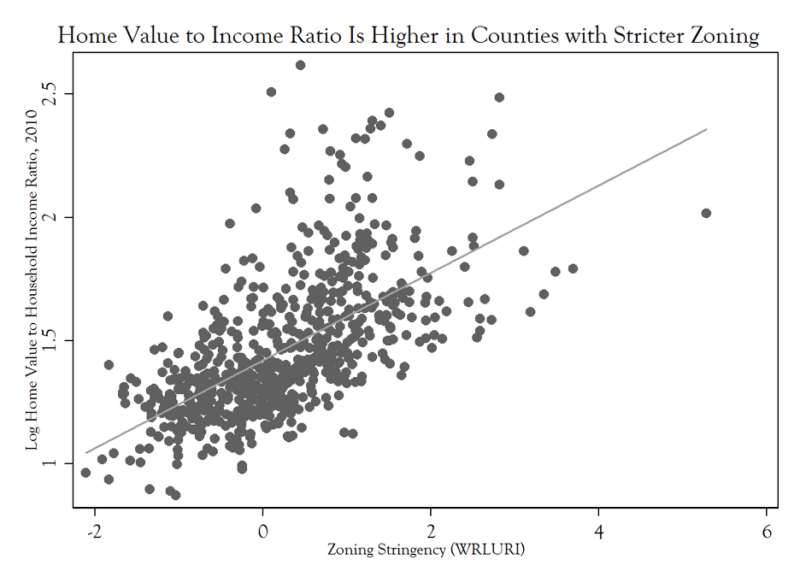
Now, the causality might go both ways. Places that are nicer to live in or boast faster wage growth will have higher housing demand and therefore higher prices and population growth. That population growth might prompt these places to tighten their zoning regulations, yielding a partly spurious correlation between regulatory stringency and housing costs.
But if that alternative causal channel were the main explanation, it would be surprising to see more strictly regulated areas experiencing slower population growth. That argument depends on zoning being the result of rapid growth, rather than the cause of high costs and slow growth. If more strictly regulated places show high costs and slow growth, that should fortify our conclusion that the high costs are a consequence of strict zoning.
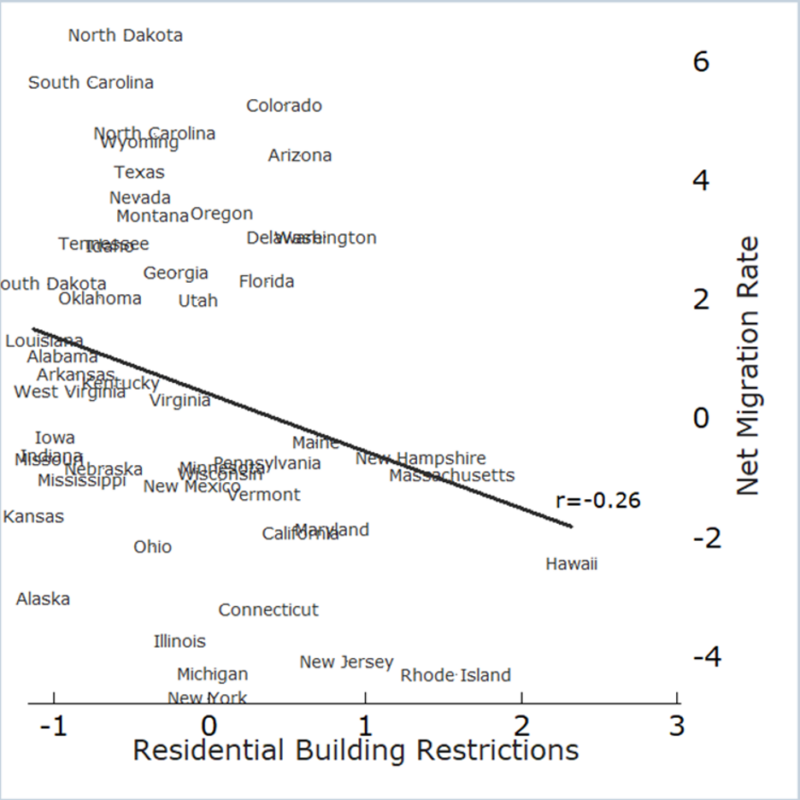
And that’s exactly what we do see. Figure 5 shows the relationship between zoning stringency and net migration rates at the state level. States with stricter zoning are losing people to states with looser zoning. This chart likely understates the negative causal effect of zoning on net migration, since states with historically high migration were more likely to tighten zoning in the first place.
These charts are suggestive and easy to understand, but from economists’ perspective, the only gold-standard evidence of causal effects comes from interventions that are more plausibly random. Careful studies of zoning regulations changes generally find that when regulations are loosened, housing production goes up, and housing costs go down, relative to the counterfactual — but the effect on costs depends on the geographic scale of the change (Cheung et al. 2023; Greenaway-McGrevy 2023; Büchler and Lutz 2024). Localized changes have almost no effect on local housing costs, while a regional change has a substantial effect on regional housing costs.
Zoning should also make commercial and industrial development more difficult and costly. In many cases, however, communities are more willing to allow commercial development than residential, since it shifts some of the property tax burden away from residential owners. This remains an area of future research, and state policymakers have been exploring ways to relax zoning rules for home-based commercial uses, such as childcare.
5. Options for Reform
Policymakers have looked to zoning reform in recent years as a way to bring down housing costs. This is a partial list of reforms that states and cities have been trying.
5.1. Institutional and Process Reforms
Process-level zoning reforms currently being tried include:
- Providing a quick appeals process or appeals board for zoning denials to reduce the time cost of development.
- Tightening who has standing or may challenge housing-friendly rezonings.
- Compensating owners for regulatory takings. Under current jurisprudence, the federal Constitution only requires compensation for regulatory takings that eliminate economically viable uses of land, necessitating state-level reforms.[3][4]
- Raising voter turnout by aligning local election calendars to state elections, as a motivated minority of anti-building homeowners have outsized pull in off-cycle elections (Einstein et al. 2020).
- Using “shot clocks” to limit the time local boards can delay permit applications.
- Allowing builders to use certified third-party inspectors and other private agencies.
- Centralizing zoning, allowing state government to define all the possible zoning districts that its local governments can use, allowing local governments to then map these districts as they like. This approach raises the risk that anti-housing groups will focus on state-level influence.
- Decentralizing zoning by allowing neighborhoods or even single streets to opt out of local zoning, if they recognize the financial benefit in allowing more housing to be built.
- Making covenants more attractive, including authorizing city governments to use their own resources to enforce private covenants (Gray 2022).
5.2. Zoning Preemption
State governments could simply preempt local zoning in some areas, giving landowners defined rights to develop certain kinds of housing.
- Build starter homes. In 2025, Texas enacted the first limit on minimum lot sizes in cities, making it easier to build subdivisions of small-lot homes.
- Promote “missing middle” reforms. Some states have ended single-family zoning in larger cities or in areas that have access to water and sewer infrastructure, allowing developers to build out the “missing middle” typologies: duplexes, triplexes, and fourplexes.
- Reduce parking minimums. Parking minimums are one of the most irrational land-use controls, and more than 100 cities have limited or abolished them.
- Legalize accessory dwelling units. Quite a few states have now passed laws giving single-family homeowners the right to build a small apartment or tiny home on their lot.
- Legalize manufactured housing. States are increasingly requiring local governments to allow manufactured housing wherever they allow single-family housing.
- Legalize single-room occupancies, allowing dorm-like arrangements with shared kitchens or bathrooms, which function as the lowest rung on the housing ladder and may do the most to reduce homelessness.
5.3. Financial Incentives
Many states now offer some financial incentives or technical assistance to local governments that want to reform zoning in a housing-friendly direction. Some states now give additional infrastructure dollars to local governments that permit more housing. New Hampshire’s Housing Champions program is an example. The ROAD to Housing Act that recently passed the US Senate would do the same with some federal funds.
Financial incentives work best when localities must demonstrate a real increase in permitting, not just a legal change, as a condition of continuing to receive the incentive. Localities have innumerable ways to block or discourage projects they don’t want, so actual permitting data reveal a community’s regulatory stance more accurately than the text of its zoning ordinances.
6. Advantages and Alternatives to Zoning
Many Americans believe that zoning serves useful functions in protecting their quality of life and property values. In established neighborhoods, private covenants are difficult to create, making zoning the primary way to govern land use. Economics helps clarify the tradeoffs of zoning and how it can be reformed to serve its essential functions at lower cost.
For more on the politics and economics of zoning and how to reform it, see my AIER white paper, “Unbundling Zoning.”
References
Bernstein, David E. 1999. “Lochner, Parity, and the Chinese Laundry Cases.” Wm. & Mary L. Rev. 41: 211.
Büchler, Simon, and Elena Lutz. 2024. “Making Housing Affordable? The Local Effects of Relaxing Land-Use Regulation.” Journal of Urban Economics 143: 103689.
Cheung, Ka Shing, Paavo Monkkonen, and Chung Yim Yiu. 2023. “The Heterogeneous Impacts of Widespread Upzoning: Lessons from Auckland, New Zealand.” Urban Studies 61 (5): 943–67.
Coase, R.H. 1960. “The Problem of Social Cost.” Journal of Law and Economics 3 (1): 1–44.
D’Amico, Leonardo, Edward L Glaeser, Joseph Gyourko, William R Kerr, and Giacomo AM Ponzetto. 2024. Why Has Construction Productivity Stagnated? The Role of Land-Use Regulation. No. 33188. National Bureau of Economic Research.
Einstein, Katherine Levine, David M. Glick, and Maxwell Palmer. 2020. Neighborhood Defenders: Participatory Politics and America’s Housing Crisis. Cambridge University Press.
Ellickson, Robert C. 2022. America’s Frozen Neighborhoods: The Abuse of Zoning. Yale University Press.
Elmendorf, Chris. 2023. “How Major Environmental Groups Ended Up on the Wrong Side of California’s Housing Crisis.” Mother Jones, November 17. https://ift.tt/z9l3Se8.
Fischel, William A. 2015. Zoning Rules!: The Economics of Land Use Regulation. Lincoln Institute of Land Policy.
Gallagher, Ryan M. 2016. “The Fiscal Externality of Multifamily Housing and Its Impact on the Property Tax: Evidence from Cities and Schools, 1980-2010.” Regional Science and Urban Economics 60: 249–59.
Gallagher, Ryan M. 2019. “Restrictive Zoning’s Deleterious Impact on the Local Education Property Tax Base: Evidence from Zoning District Boundaries and Municipal Finances.” National Tax Journal 72: 11–44.
Glaeser, Edward L., Joseph Gyourko, and Raven Saks. 2005. “Why Is Manhattan So Expensive?: Regulation and the Rise in Housing Prices.” Journal of Law and Economics 48 (2): 331–69.
Glock, Judge. 2022. “Two Cheers for Zoning.” American Affairs 6: 36–52.
Gray, M. Nolan. 2022. Arbitrary Lines: How Zoning Broke the American City and How to Fix It. Island.
Greenaway-McGrevy, Ryan. 2023. “Can Zoning Reform Reduce Housing Costs? Evidence from Rents in Auckland.” Working Paper No. 16. Preprint, University of Auckland Economic Policy Centre.
Gyourko, Joseph, and Sean E. McCulloch. 2024. “The Distaste for Housing Density.” NBER Working Paper 33078.
Hirt, Sonia. 2014. Zoned in the USA: The Origins and Implications of American Land-Use Regulation. Cornell University Press.
Hsieh, Chang-Tai, and Enrico Moretti. 2019. “Housing Constraints and Spatial Misallocation.” American Economic Journal: Macroeconomics 11 (2): 1–39.
Hughes, Samuel. 2025. “The Great Downzoning.” Works in Progress, November 24. https://ift.tt/AothCYl.
Lin, Chuanhao. 2024. “Do Households Value Lower Density: Theory, Evidence, and Implications from Washington, DC.” Regional Science and Urban Economics 108: 104023.
Molloy, Raven. 2020. “The Effect of Housing Supply Regulation on Housing Affordability: A Review.” Regional Science and Urban Economics 80 (C): 1–5.
Peterson, Sarah Jo. 2023. “The Myth and the Truth About Interstate Highways.” In Justice and the Interstates: The Racist Truth About Urban Highways, edited by Ryan Reft, Amanda K. Phillips de Lucas, and Rebecca C. Retzlaff. Island.
Power, Garrett. 1983. “Apartheid Baltimore Style: The Residential Segregation Ordinances of 1910-1913.” Maryland Law Review 42 (2): 289–328.
Rothstein, R. 2017. The Color of Law: A Forgotten History of How Our Government Segregated America. Liveright. https://ift.tt/vMrW5NS.
Scott, James C. 1998. Seeing like a State: How Certain Schemes to Improve the Human Condition Have Failed. Yale University Press.
Siegan, Bernard H. 1972. Land Use Without Zoning. Rowman & Littlefield.
Sorens, Jason. 2018. “The Effects of Housing Supply Restrictions on Partisan Geography.” Political Geography 66 (September): 44–56.
Sorens, Jason. 2021. Residential Land Use Regulations in New Hampshire: Causes and Consequences. Josiah Bartlett Center for Public Policy.
Speyrer, Janet Furman. 1989. “The Effect of Land-Use Restrictions on Market Values of Single-Family Homes in Houston.” Journal of Real Estate Finance and Economics 2 (1): 117–30.
Trounstine, Jessica. 2020. “The Geography of Inequality: How Land Use Regulation Produces Segregation.” American Political Science Review 114: 443–55.
Endnotes
[1] For example, in 1915 San Francisco adopted an ordinance forbidding laundries in certain neighborhoods. Because these laundries were overwhelmingly Chinese-owned, this was a way of trying to keep Chinese workers out of wealthier neighborhoods (Bernstein 1999). Between 1911 and 1917, Baltimore, Louisville, and other cities adopted ordinances forbidding blacks and whites from living in neighborhoods majority occupied by members of the other race, ordinances struck down by the US Supreme Court in Buchanan v. Warley (1917) (Power 1983).
[2] This kind of deal is what economists call a “Coasean bargain” (Coase 1960). It makes no sense for regulations to prohibit people from making m utually beneficial exchanges.
[3] Arizona and Florida have laws requiring local governments to compensate landowners if they take away much of the value of their property through new zoning laws. Oregon had such a law, but it was radically scaled back.
[4] Penn Central Transportation Co. v. New York City, 438 US 104 (1978). 3): 454-466.





0 Comments