

In early July, the Federal Reserve named the leaders of five task forces charged with reviewing how it conducts monetary policy. At the helm of the inflation task force are Harvard economist Greg Mankiw, Nobel laureate Thomas Sargent, and William White, former chief economist at the Bank for International Settlements. Chairman Kevin Warsh asked them to “examine the drivers of inflation, first principles, and weigh the full range of ideas for delivering price stability in a changing economy.” That charge is broad enough to cover an option the Fed has never seriously tried: targeting the total amount Americans spend rather than the prices they pay. It should.
Consider 2021. Prices began climbing early that year, and for months then-Chair Jerome Powell called the increase “transitory,” a blip from pandemic supply snarls that would fade on its own. By November, with prices still rising, Powell told Congress it was time to “retire” the word. Weeks later, the Fed’s December projections still put 2022 inflation at 2.7 percent. It came in at 4.7 percent, nearly double. The Fed had every piece of data anyone could want and spent most of a year misreading what was in front of it.
The problem isn’t careless officials. The Fed’s approach makes them answer a hard question before they can act: is inflation coming from the producing side, or from people spending more? The Fed needs to decide if it’s the former (a supply-driven shock that the Fed can’t fix) or the latter (a demand-driven change that the Fed can influence). In 2021, the Fed had to decide whether rising prices meant supply chains sorting themselves out or an economy spending faster than it could produce. That call is difficult to get right in real time. The Fed got it wrong for the better part of a year, and households paid for the Fed’s error as their savings and paychecks lost value.
Targeting spending sidesteps the question. Rather than focus on a price index and judge, shock by shock, which price changes deserve a response, the Fed would aim at the total dollar value of everything the country spends, what economists call nominal income, and keep it growing at a steady, predictable rate. If spending stays on that path, no one has to rule on whether a particular price change will last. Instead, they simply ask if total spending is growing too fast, too slow, or about right. Had the Fed been steering spending in 2021 instead of parsing the nature of the inflation, data would have shown that nominal income after COVID-19 grew at a faster pace than normal, pointing to persistent (not transitory) high inflation rates.
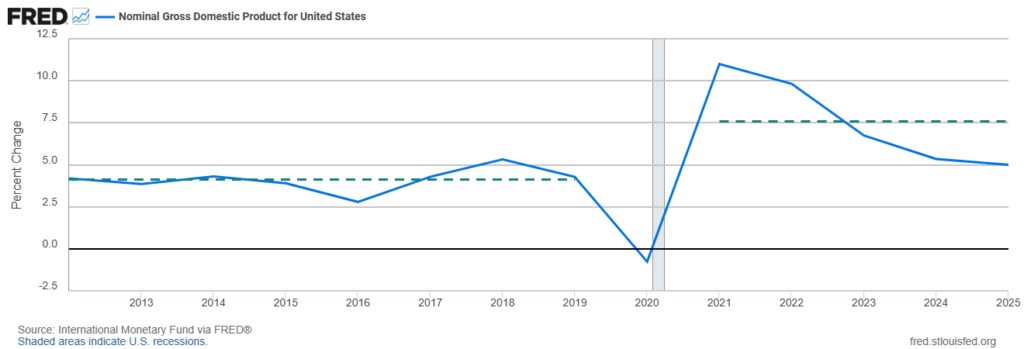
This task force’s three members are unusually well positioned to press the case — not simply a random assortment of credentialed names.
Mankiw, who wrote what’s become the most widely used undergraduate economic textbook and chaired the Council of Economic Advisers under President George W. Bush, has spent decades writing the standard account of how mainstream macroeconomics thinks about inflation, which makes him a natural voice for testing that account’s limits. Sargent, a New York University economist who won the Nobel Prize in 2011, built his career on the idea that policy works best when it follows a clear, credible rule rather than case-by-case discretion, exactly the kind of framework question this task force exists to ask. White, former chief economist at the Bank for International Settlements (BIS), the central bankers’ central bank, has spent years arguing that narrow inflation targeting missed the imbalances that led to the 2008 financial crisis. He is perhaps the panel’s most persistent critic of the status quo before it even convenes. The panel members demonstrate establishment credibility with a documented record of independent, sometimes unpopular judgment.
Interestingly, Warsh didn’t ask the three to fine-tune how the Fed explains its current approach. He asked them to examine “first principles” and weigh “the full range of ideas.” A review with that charge has no good reason to bury spending targets in a footnote next to the small adjustments the Fed has already made. For example, Sargent has spent much of his career arguing for rules over discretion; getting spending is a simple rule. A panel with his name on it has the unique opportunity to push the Fed to think outside its box.
None of this guarantees an outcome. The task force could conclude that the Fed needs better messaging, or a modest change like the one made in 2020, and move on. That would be a missed opportunity. The 2021 episode was not a story about a Fed short on information. It was a story about a target that required the Fed to answer a difficult question, and the answer arrived in grocery bills and rent checks. This task force has the mandate and the people to ask a bigger question. The Fed does not need to get better at guessing whether a price increase is a response to a nominal or real shock. It needs a target that does not depend on the guess.





0 Comments