

Vacancy taxes are a popular idea among that segment of the left that is still resisting supply-side reforms as the economically literate solution to the housing crunch. But the number of perfectly decent housing units sitting vacant year-round in desirable markets is vanishingly small, and owners will respond to vacancy taxes in undesirable ways too.
Vacancy taxes have been in vogue recently. France has a nationwide housing vacancy tax, Ottawa implemented one a few years ago, Washington, DC has enacted a vacancy tax on both residential and commercial properties, and San Francisco has an active commercial vacancy tax.
Do these vacancy taxes reduce rents? The best available evidence says no. These taxes do appear to reduce vacancies, but it is unclear whether they also reduce housing supply. After all, one way to avoid a housing vacancy tax is to reclassify a structure as nonresidential, such as by removing the kitchen.
Some people seem to be under the impression that landlords are hoarding a large number of long-term vacant units for no apparent reason. Supposedly they do this because they are “speculating” on the vacant units. But if you’re speculating on housing, why wouldn’t you rent it out and make some extra income while you’re seeing if the underlying value will rise?
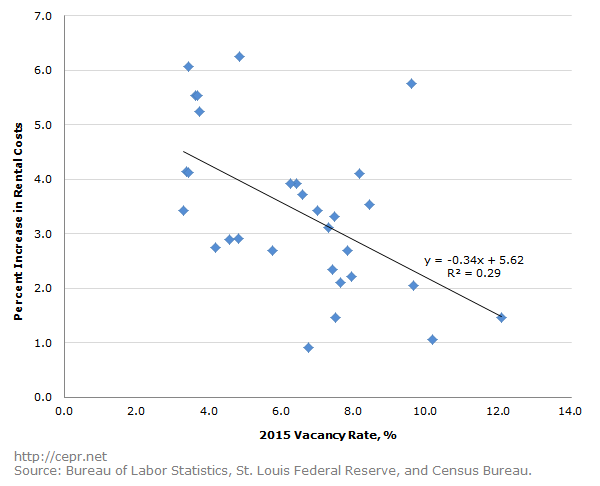
In fact, when more housing units become vacant, rents fall. This is an extremely clear relationship, validated by sophisticated scholarship as well as the plain evidence of one’s eyes. Here’s a chart from the left-leaning Center for Economic and Policy Research (Figure 1). High vacancy rates are followed by declines in rental costs.
And here are two charts of Austin, Texas recently posted by Nolan Gray on X (Figure 2). Vacancy rates in Austin fell dramatically right before rents rose equally dramatically. Then as rents fell back, vacancy rates rose again.
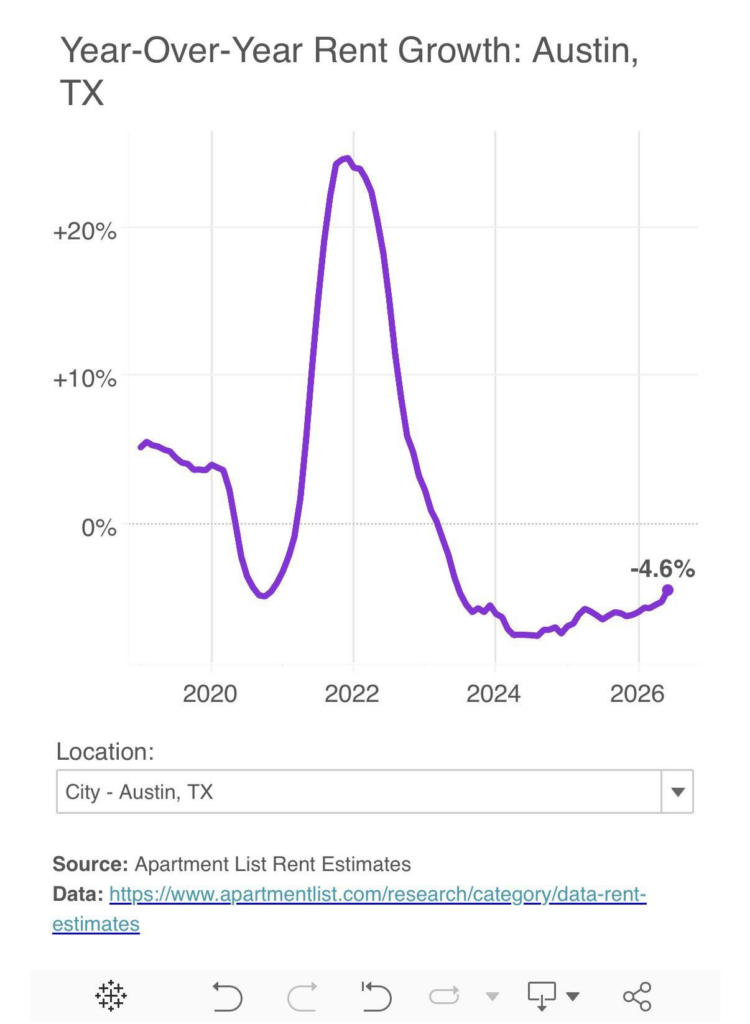
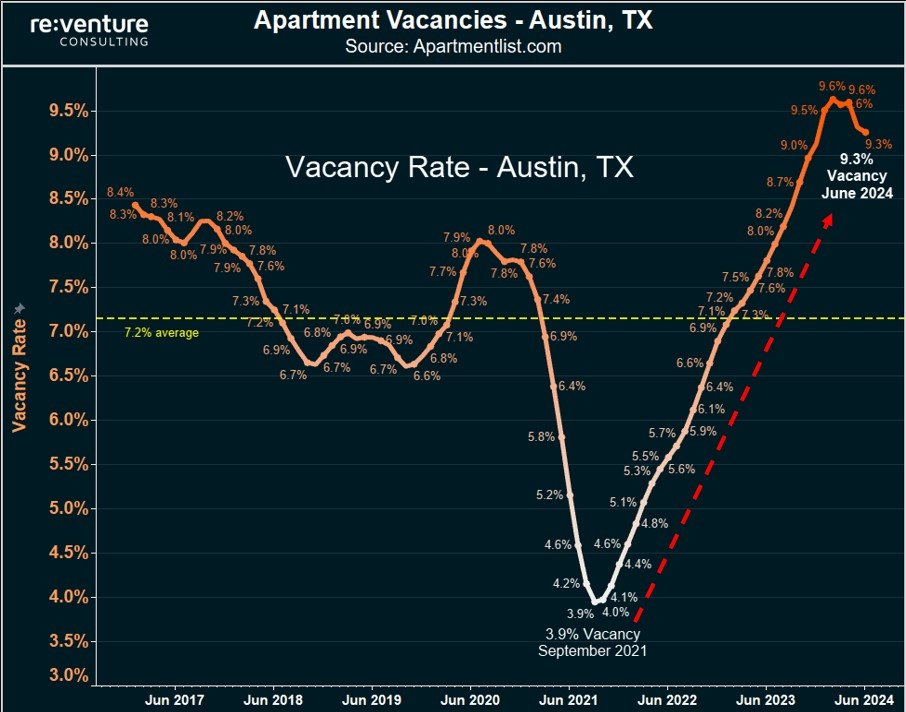
When housing providers have vacant units, they cut rents to attract renters. That’s just basic economics.
In most cases, it makes no sense to hold property and pay property taxes and insurance on it while making no income from it, even in the absence of vacancy taxes. When Ottawa enacted a vacancy tax, it found that it applied to only a few thousand units. As of 2023, 4,140 dwelling units had to pay the vacancy tax there, amounting to 1.2 percent of the housing stock to which the law applies and 1.0 percent of the total housing stock. Glenn Gower frames the tax as a success because between 2022 and 2023, 1,602 previously vacant housing units became occupied. But even if we assume that every single one of these newly occupied units was driven to the market by the vacancy tax, that’s just 0.4 percent of Ottawa’s housing stock, with an infinitesimal effect on rents under any reasonable assumptions about the elasticity of housing demand.
It’s unclear whether vacancy taxes will even reduce rents on net. Will housing providers treat vacancy taxes paid as another cost of business that they must recoup from their tenants? If so, they may raise rents on already-occupied units to cover the cost of the vacancy tax.
In fact, there are a few rare cases when it does make sense to leave a unit vacant. For example, if the unit is substandard and requires massive, costly renovations that one cannot yet afford to perform, it may be better to keep the unit vacant rather than undermine one’s reputation and brand in the community by renting out a substandard unit that elicits complaints and perhaps even unfavorable regulatory attention. Thus, a vacancy tax may disproportionately force substandard units into the market.
Second homes are also typically vacant for a majority of the year, making them potentially subject to vacancy taxes. Zohran Mamdani’s pied-a-terre tax in New York is apparently intended to deter people from having second homes in the city, with the idea that these homes will be made available to full-time residents.
But let’s think through the consequences of deterring high-net-worth individuals from visiting and spending time in New York. How will these changes affect the important retail, hospitality, entertainment, and arts industries in the city? Will the tenants helped by a small number of second homes’ coming to market lose more in wages and employment from the second-order effects of the tax?
One final reason why a housing provider might hold a unit back from the market is that rent controls and eviction protections could mean that the rental income would not cover the operating cost of renting out the unit. These are reasons to roll back rent control and eviction protections rather than force housing providers to take losses. After all, if the owners of rental buildings find that their line of work has negative returns, they will try to get out of it. And that could mean, alongside deferred maintenance, condoization, demolitions, and residential-to-commercial conversions, a decline in multifamily structure property values, putting more of the property tax burden on everyone else in the city. Indeed, New York’s tightening of rent stabilization in 2019 has done just this, even playing a role in forcing Signature Bank into FDIC receivership and New York Community Bancorp into near-collapse.
What about vacancy taxes on commercial properties, as Washington, DC and San Francisco have enacted and Tacoma, Washington is considering? High commercial vacancy rates in the 2020s are a legacy of the pandemic and the rise of work-from-home. Commercial rents and values have already dropped to rock-bottom in much of the country. Will punishing these owners with vacancy taxes help the situation? Owners of vacant commercial buildings need more cash flow and collateral to finance conversions, not less. (It’s also not clear that owners will comply with commercial vacancy taxes: San Francisco’s commercial vacancy tax has resulted in widespread underreporting.)
The solution to vacant commercial buildings is to reform local zoning rules and permitting processes to speed conversion of these structures to other uses. If necessary, cities could also consider tools like land-value taxation or tax-increment financing (TIF) to reduce the extent to which property taxation disincentivizes value-increasing improvements. These solutions face their own limitations, from the difficulty of assessing the unimproved value of urban land to the potential for TIF to be a tool of cronyism, but at least they rely on improving the financial strength of partners in development, not harming it.
Even if vacancy taxes work exactly as designed, they are not a major solution to the housing crunch. Their positive and negative effects are generally small. The biggest problem with vacancy taxation is its use as a totem by people who oppose housing solutions that would make a real difference, namely, making it easier and less costly to build housing.





0 Comments