

A common narrative from politicians on the right is that immigration is economically disastrous. President Trump has argued that “immigration costs our country billions and billions of dollars each year.” In an interview, Vice President JD Vance went further, arguing that under former President Biden “all net job creation — you heard me right, 100 percent of net job creation under the Biden administration — has gone to the foreign-born.”
Trump’s Commerce Secretary Howard Lutnick has called the H-1B visa system “a scam that lets foreign workers fill American jobs.” But despite the fairly consistent narrative on immigration’s economic impacts from elected Republicans, most Americans think immigration has positive economic benefits. And new data continues to bear this out.
Nearly 50 percent of Fortune 500 companies in 2025 (231 out of 500) were founded by immigrants or their children. In fiscal year 2024, “these 231 Fortune 500 companies generated $8.6 trillion in revenue — an amount that, if compared with national GDPs, would rank as the third-largest economy globally.” What’s more, immigrants are founding not just industry giants but also some of the most dynamic and innovative companies, too — startups.
According to an analysis by National Foundation for American Policy, “[i]mmigrants have founded or co-founded 59 percent (455 of 775) of America’s privately held startup companies valued at $1 billion or more.” And even startups that aren’t founded by immigrants often have immigrants in key leadership roles. The analysis found that nearly 80 percent of America’s unicorn companies (privately held, billion-dollar companies) were either founded by an immigrant or have an immigrant in a key leadership role, like vice president of engineering.
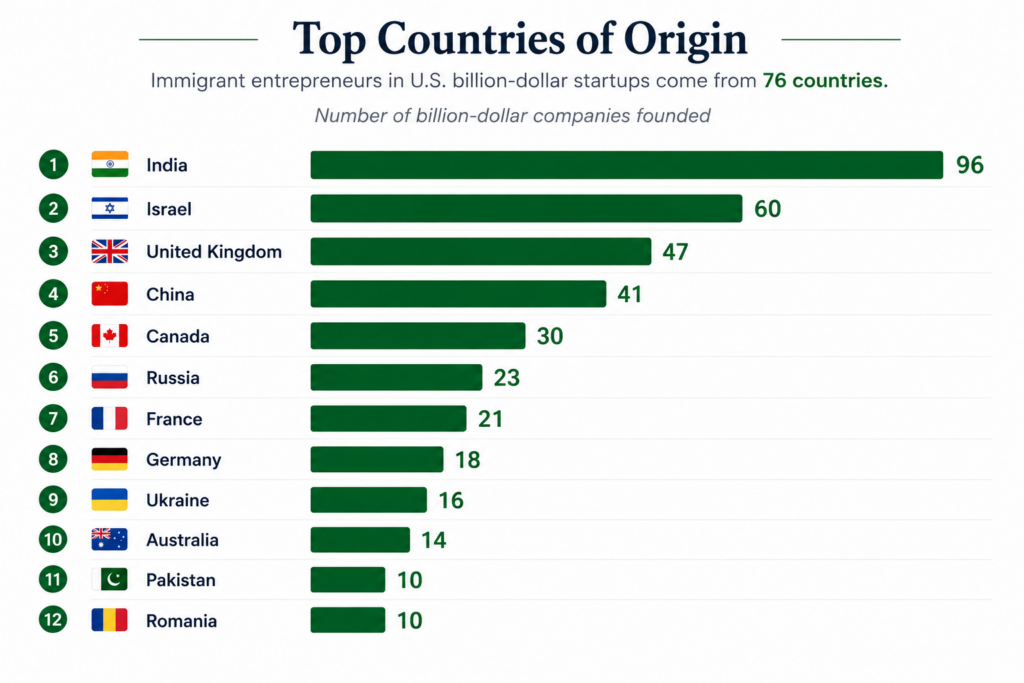
Take a specific immigrant population as an example. Indian immigrants to the United States have, alone, founded 96 billion-dollar startups.
Today, there are approximately 3.2 million Indian immigrants in the United States. That means about one in every 30,000 Indian immigrants has founded a billion-dollar startup. And each of these billion-dollar startups creates 833 jobs, on average.
Now, one response to these statistics is that Americans could just as easily create these startups, but a 2025 study from the National Bureau of Economic Research puts that into question. The study’s analysis of nearly 91,000 US startups found that companies with mixed founder teams (immigrants and US-born entrepreneurs) grow faster, employing 20 percent more people than US native-only ventures three years after launch. They also raise larger funding rounds and are more likely to be acquired or go public.
The researchers suggest these benefits stem from immigrants’ broader access to global talent networks, cross-border capital, and foreign markets. Compared to native-only startups, native-migrant startups hire higher quality workers (using internal and external promotions as a proxy for labor quality). By drawing from a larger labor pool, startups that incorporate immigrants simply have better, higher-quality labor. That same dynamic shows up in startup financing and market access. Immigrant-founded firms are not just producing more than twice as many patents; they are also more likely to patent abroad, suggesting that immigrant founders are often better positioned to draw on international capital networks and reach customers beyond the US market.
While there is a debate to be had about low-skilled immigration (and particularly, illegal immigration), the Trump Administration is going after immigration broadly — including high-skilled immigration. New screening requirements, tougher vetting, and higher costs are also affecting people seeking to come to the US legally for work or study. Last year, Trump signed a proclamation overhauling the H-1B visa program, one of the most common pathways for highly skilled foreign workers, by imposing a new $100,000 application fee (which is in effect, though under appeal, at time of writing). The Trump Administration is also subjecting green card applicants to “anti-Americanism” screening, while student visa applicants must now undergo social media vetting. A special visa for STEM PhDs and startups passed the House of Representatives in 2022, but Senator Grassley blocked its inclusion in the CHIPS and Science Act.
And there’s a good chance these additional barriers mean that the US could be missing out on our next billion-dollar startup.
Take the newly added barriers on student visas: almost one in four US billion-dollar companies — 24 percent — was founded by someone who first came to America as an international student. These companies have generated an average of 1,123 jobs each. Together, US billion-dollar companies with international-student founders are valued at $3.5 trillion — or more than $4 trillion when including unicorns that have gone public since 2016.
Interestingly, while Republican politicians continue to make high-skilled immigration more difficult, Republican voters — though skeptical of immigration generally — are broadly in favor of high-skilled immigration. A 2025 poll from the Manhattan Institute, for instance, found that only nine percent of Republican voters think high-skilled immigration should be decreased.
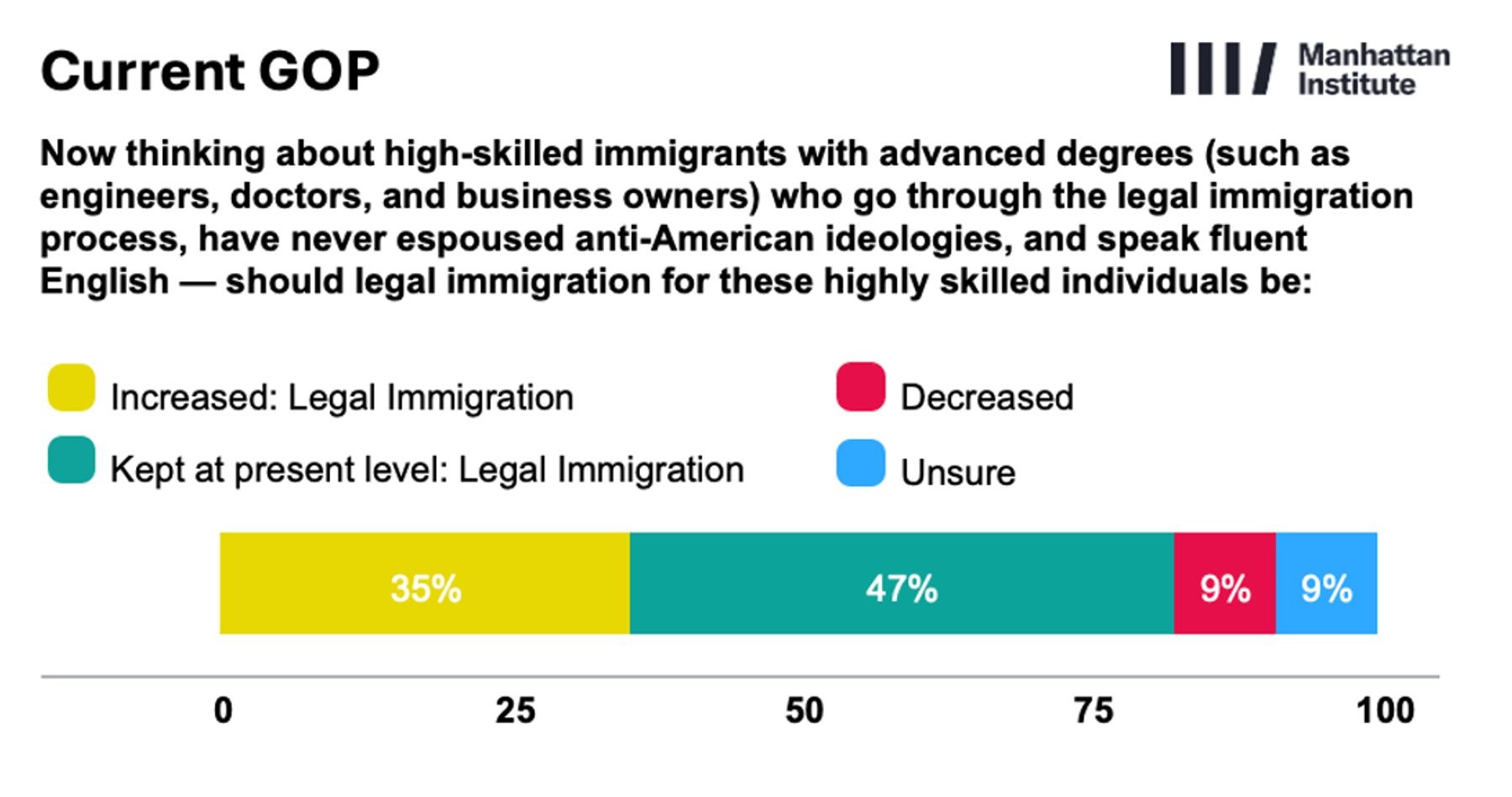
The Trump Administration’s policies, unfortunately, will almost certainly decrease high-skilled immigration going forward.
“President Trump has reduced illegal entries since Inauguration Day in January 2025, but … his administration has reduced legal entries far more,” David Bier writes for Cato. Confirming that trend, two indicators of high-skilled immigration — student visas and H-1B visas — are significantly down. Visas for international students were down by 40 percent in the summer of 2025, with high rates of refusal. And H-1B visas are likely down by at least 25 percent.
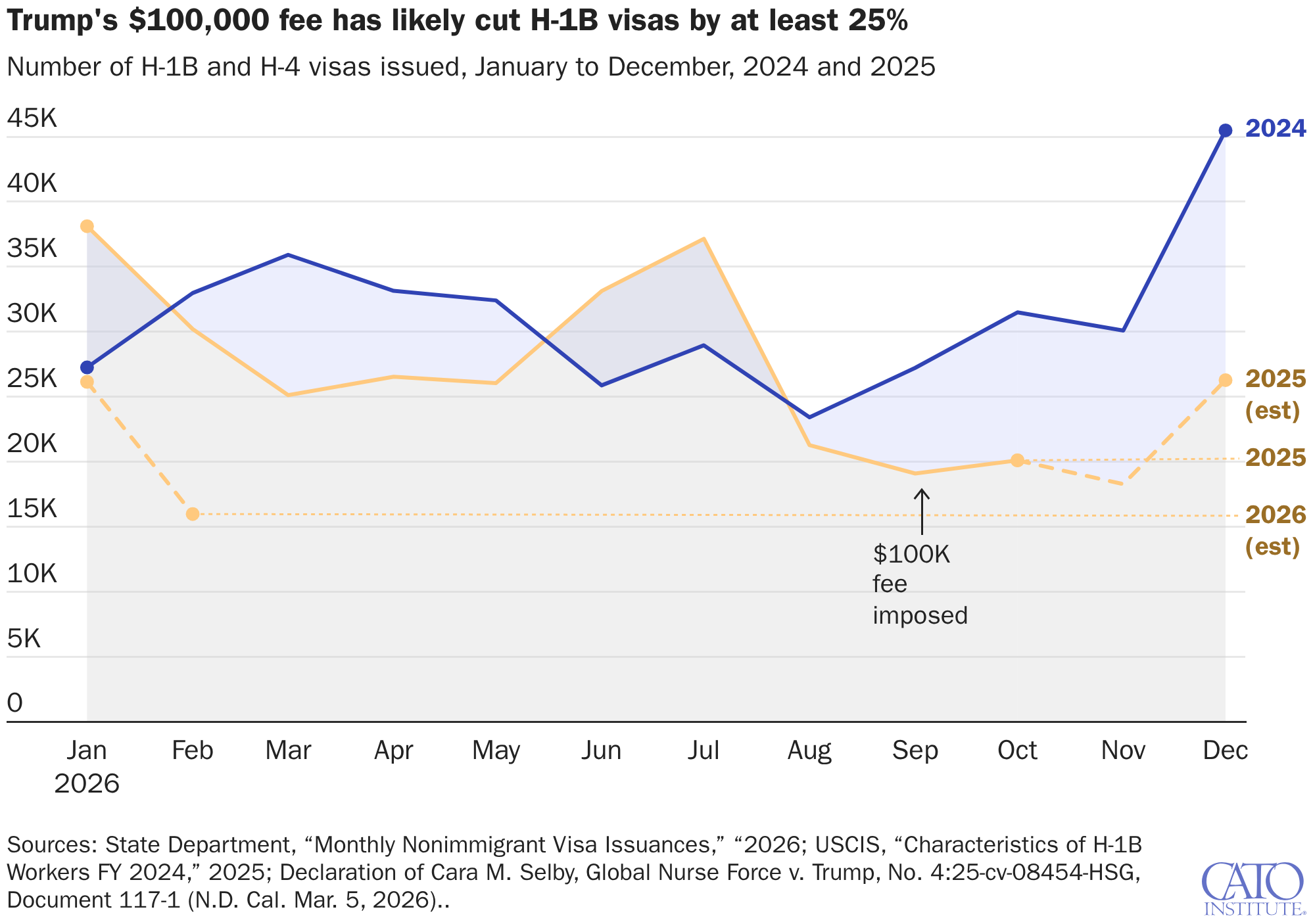
These policies are not just making the country less welcoming to high-skilled immigrants; they are weakening US prosperity, reducing future innovation, and almost certainly worsening the federal fiscal picture. More importantly, they expose the central misconception about the Trump Administration’s immigration agenda. This is not simply an effort to stop illegal immigration. It is a broader campaign to restrict immigration across the board, including the very forms of legal immigration that have helped make the United States the world’s leading destination for talent, entrepreneurship, and economic dynamism. As Americans debate what immigration policy should look like, that reality should be impossible to ignore.





0 Comments